American Mussar

21st century Jewish spiritual practice for an authentic and meaningful life

  • About
    • About Greg Marcus
    • Frequently Asked Questions – American Mussar FAQ
    • Blog
    • Sign Up For the American Mussar Newsletter
    • Contact
    • Mantra Cards
      • Cart
  • Personal Transformation
  • Get Closer To Judaism
  • Empower Your Institution
  • Soul Trait Quiz
  • Book
    • Mussar Books

My Dad Had a Stroke. Mussar Spoke.

October 28, 2016 By Greg Marcus 1 Comment

my dad had a stroke
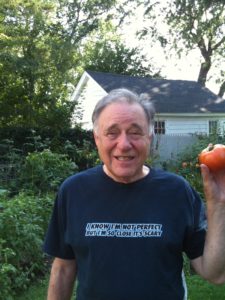
David Marcus with tomato

I’ve often said that my soul traits follow me around, but this is ridiculous. I am currently leading three Mussar groups, and my personal practice was out of sync with all of them. But after a very intense discussion about the soul trait of Loving Kindness in one of the parenting groups, some instinct told me to start on Loving-Kindness right away. We practice Loving Kindness by helping other people without the thought of reward even if they do not deserve it.

Mussar teaches that the world is built on acts of Loving Kindness. There are a few classical examples of acts of Loving Kindness, that include burying the dead, clothing the naked (usually interpreted as taking care of the poor), and visiting the sick. In each case, we are doing something that is uncomfortable, and we are not in a position to get anything in return.

Just a few days later, my cell phone rang when I was getting a decaf almond milk latte at Peets. It was my stepmother. “Oh no,” I thought. “She never calls my cell phone.”

As I feared, the news was not good:. My dad had a stroke.

My parents are divorced, and I lived with my father growing up. Suddenly this man who had raised me is weak on one side of his body, and is having trouble speaking. I feel numb in the moment, and very helpless living on the other side of the country. I wander in the street outside Peets, asking my stepmother to pause as the train blares its way into the station. It is surreal. Then I talk to him on the phone. He speaks with energy, and obvious mental clarity, but I don’t understand the words coming out of his mouth. They are slurred. Very slurred.

To be honest, I was confused about what I should do. I live in California, he lives in Syracuse. The emergency wasn’t so dire that I had to leave immediately. With my wife was in Europe, I needed to take care of the kids. I talked with my stepmother about when to come out. Our initial conversations were very much in head space – “practical considerations” about when I could be most helpful. This week, next week, the following week… Each had it’s advantages when I could be there to help with various things.

Then I sat down to journal that night, and a quiet voice spoke to me. It said “visit the sick.”

“Visit the sick” has no time qualifications attached to it. It purely exists within heart space.
And I knew what I had to do.

The voice of someone in my father’s generation came to me – “I don’t need an ancient Rabbi to tell me the right thing to do.” True. Mussar does not tell us the right thing to do. We already know it most of the time. As Rabbi Eliyahu Dessler put it, Mussar helps the heart understand what the mind already knows. Whether we like to admit it or not, the heart is in charge. The heart is stronger than the head.

So off I went to Syracuse less than 24 hours after my wife got back in town. I thought a lot about Maimonides rules for visiting the sick. They include:

  • Don’t stand over the sick person, and don’t sit on their bed. Sit on the floor or a chair
  • Don’t bring bad news, and don’t be Pollyanna about their condition either
  • Bring a gift
  • Ask permission

I am back home now. He is doing ok, but the road ahead is long. It was a hard trip, but not nearly as hard as as I thought it would be. Time flowed differently for me the last few days. I spent a lot of time just sitting, just being there.

These rules give me something to hold on to. And they remind me of a greater truth – we visit the sick to preserve human dignity, to sanctify life, and to honor the Divine Spark in all of us.

[button]Never miss a post[/button]

Filed Under: Loving-Kindness Tagged With: caring for the sick, chesed, dad stroke, father stroke, loving-kindness, Mussar, Rabbi Eliyahu Dessler

Mussar Practice Essential: Understanding Mussar Choice Points

August 31, 2016 By Greg Marcus 8 Comments

understanding mussar choice points

The Choice Point is a fundamental element of Mussar practice. It is the moment when we are balanced between doing the right or the wrong thing. When we are awake, we see the choices in front of us, and are better positioned to exercise our free will. This excerpt, from my book “The Spiritual Practice of Good Actions,” explains the importance of Understanding Mussar Choice Points.

Rabbi Eliyahu Dessler one of the foremost Mussar masters of the early 20th century, describes the struggle between the Good and Evil Inclinations as a battlefront. Behind the front lines, our actions are firmly entrenched such that we act without thinking to follow either the Good or Evil Inclination. When we are at the boundary, however, we are faced with a choice, and feel the pull towards both positive and negative behaviors. Rabbi Dessler called this a choice point.[1] For example, stopping at a red light under ordinary circumstances is in the category of an automatic behavior in the area of the Good Inclination. However, if we are running late, we may be tempted to race through the intersection while the light is changing. Choice points are critical, since that is where we have an opportunity to exercise free will, and decide which way to go. We might make a decision to do right by our Soul, or to follow the Evil Inclination. It is only a choice point if the decision could go either way.

This picture of the confluence of the Rhone and Arve rivers illustrates the metaphor of the battle between the Good and Evil Inclinations. Imagine that you on a boat traveling towards the confluence of the clear and muddy rivers. In some parts of our life, we generally do the right thing and thus are sailing through the clear waters on the left side. In other areas, however, our weakness hold sway, and we are in the habit of following our base instincts in the cloudy water. In the middle, there is a grey area, where our spiritual challenges lie. The boundary is jagged, uneven, and in constant flux. There are places where the good juts out a bit or the Evil Inclination is starting to permeate under the Good Inclination. Each action we take influences our Soul, making it more likely that we will make a similar decision in the future. Thus when we follow the Good Inclination, the boundary is pushed to the right. When we follow the Evil Inclination, the boundary is pushed to the left. Dessler supports this conclusion by citing Ethics of the Fathers, which says “One sin leads to another,” and the Talmud, which teaches, “as soon as one has committed a sin twice, it is no longer a sin for him.”[3] In America, we call this phenomenon the slippery slope.

Rabbi Dessler teaches us that our choice points are a product of our education, environment, and state of spiritual development.[4] Two people with different spiritual curriculums will face very different choice points day to day. For example, lets compare the choice points between two men, one righteous, and the other a thief. For the thief, the choice point is whether to take the television but leave behind the Blu-Ray player. For him, that would represent a great step forward since he did not commit as big a crime as he usually did. The challenge for the righteous person is to give to charity with a feeling of Loving-Kindness instead of out of obligation.[5]

We all have issues. Mussar concerns the point of choice, that moment of conflict when we have to choose between being patient, or yelling at the kids to hurry up and get out the door. Choice? When I start yelling it doesn’t feel like a choice, it just comes out. While this is true, amazingly enough, two weeks after I began to focus on the Soul Trait Patience I experienced a dramatic change in my typical behavior. My kids were slow getting out the door in the morning, and I opened my mouth to yell at them. In that moment, I recognized them as little divine Souls, just playing around and not giving a fig about getting to the car. I closed my mouth and smiled.

In that moment, I chose to sail in clear waters.

“Excerpt from “The Spiritual Practice of Good Actions” by Greg Marcus, PhD © 2016 by Greg Marcus, PhD. Used by permission from Llewellyn Worldwide, Ltd., www.Llewellyn.com.”  Order now on Amazon

Image credit: La Jonction used with permission from S. Brandt.

[1] Rabbi E. E. Dessler, Strive for Truth, reprinted on Torah.org, accessed August 7, 2015, http://www.torah.org/features/spirfocus/FreeChoice-point2.html.

[2] Go to http://americanmussar.com/wp-content/uploads/2016/08/Figure-4.1-Mussar.jpg  to look at this picture in more detail.

[3]Avot 4:2 and Talmud, Yoma 86b.

[4] Rabbi Eliyahu E. Dessler, Strive for Truth!, trans. Aryeh Carmell (Jerusalem: Feldheim, 1978), 54-55.

[5] Derived from an example from Rabbi E.E. Dessler shared by Morinis in Everyday Holiness, 23.

[button]Never miss a post[/button]

Filed Under: Featured, Mussar Basics, Mussar Practice Tagged With: bechirah point, choice point, Mussar, mussar practice, Rabbi Eliyahu Dessler

Search

Recent Posts

  • How Much Space Should I Take Up? A Mussar Reflection on Humility
  • When 9/11 and Elul Collide: A Mussar Reflection on Life and Death
  • Psalm 27 2025 Workshop Materials
  • Finding Awe During Life Transitions: A Mussar Perspective
  • Five Mussar Traits to Help You Move

LINKS

  • Judaism Unbound
  • The Mussar Institute
  • Center For Contemporary Mussar
  • Character Day
  • Kirva
  • Rabbi Chaim Safren video blog

Copyright © 2025 · Greg Marcus | Site-AskMePc | Log in